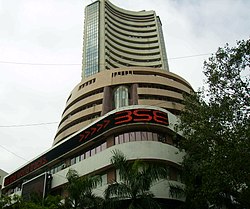
The Sensex closed at 77,472.94 on Wednesday, down 183.15 points, or 0.24%. The Nifty 50 fell 126.80 points, or 0.52%, to 24,207.75. Read only those two numbers and the story writes itself: a down day, IT stocks weighing on the index, investors booking profits ahead of US inflation data. All of that is accurate. It is also a smaller and less interesting story than what actually happened underneath it, because while the two headline indices were closing red, the BSE 150 MidCap Index rose 0.17% and the BSE 250 SmallCap Index rose 0.56%. More stocks went up on Wednesday than went down. The market did not have a bad day. Three stocks did, and they happen to be large enough to move the number everyone reads.
Why thirty stocks can outvote hundreds of others
The Sensex and Nifty are free-float market-cap-weighted indices, which means a handful of India's largest companies carry outsized influence over where the number lands, regardless of how the other 4,000-odd listed stocks on the NSE and BSE actually traded that day. Wednesday's losers table makes the mechanism obvious: Infosys fell 1.84%, Power Grid fell 1.77%, and Bharti Airtel fell 1.70%. All three are among the heaviest weights on the Nifty. A percent-and-a-half move in Infosys alone moves the index more than a percent-and-a-half move in twenty mid-cap stocks combined, purely because of how much of the index Infosys represents. That isn't a flaw in how the index is built — cap-weighting is standard practice globally, and it's genuinely useful for tracking the value of the broad market in aggregate. But "the index fell" and "the market fell" are two different claims, and Wednesday is a clean example of the first being true without the second following automatically.
| Losers | % move | Gainers | % move | ||
|---|---|---|---|---|---|
| 1 | Infosys | -1.84% | Kotak Mahindra Bank | +3.70% | |
| 2 | Power Grid | -1.77% | UltraTech Cement | +2.04% | |
| 3 | Bharti Airtel | -1.70% | Axis Bank | +1.69% |
Kotak Mahindra Bank's 3.70% gain on its own did more to prop up the Nifty than most of Wednesday's other movers combined — and it's a reminder that even on a "red" day, the single biggest individual move on the index was actually upward.
The sector split tells the same story a different way
Nifty IT was the day's clearest laggard, down over a percent and the single biggest drag on both indices, with FMCG, Auto and Realty also closing lower. Nifty Metal, Nifty Private Bank and Nifty Cement moved the other way. That's not a market rotating out of equities on bad news — it's a market rotating between sectors on a fairly specific, identifiable trigger: traders booking profits and de-risking ahead of Wednesday's US inflation print and Nvidia's earnings, both landing at a moment when West Asia tensions have been easing and crude has softened as a result. IT stocks, with their revenue tied to US client budgets and dollar-denominated contracts, are the most directly exposed to anything that shifts the US rate outlook, which is exactly why they led Wednesday's losers while domestically-focused banks and cement — names whose earnings depend on the Indian economy, not the US Fed's next move — held up or gained.
What "market breadth" is actually measuring
Market breadth is the technical term for exactly this gap: how many stocks are advancing versus declining, independent of what the cap-weighted headline number says. A day with a falling index and positive breadth — more advancers than decliners — reads as a market where the damage is genuinely concentrated in a small number of heavyweight names, rather than a broad-based sell-off that happens to have been cushioned by a few outliers. Wednesday was that kind of day twice over: at the index level, three large-cap names did almost all of the damage, and at the breadth level, the wider market of mid- and small-cap stocks was net positive.
This isn't a claim that the SmallCap Index rising 0.56% "matters more" than the Sensex falling 0.24% — they're not directly comparable numbers, tracking different baskets with different weighting logic, and a good small-cap day doesn't cancel out large-cap weakness for anyone who actually holds Nifty-heavy funds or the specific stocks that fell. What it does mean is that a single index close, taken alone, tells you almost nothing about whether "the market" had a good or bad day for the average listed company, or for a portfolio that isn't concentrated in the three or four stocks doing the heavy lifting on any given afternoon.
Why this is worth knowing beyond Wednesday
The pattern repeats often enough that it's worth internalising rather than re-deriving every time a headline says the Sensex is up or down: on any given day, check whether the move is broad or concentrated before drawing a conclusion about market sentiment from the index number alone. A concentrated move — a handful of heavyweight stocks doing almost all the work, in either direction — says more about those specific companies and the news driving them than it says about the market as a whole. A broad move, where advancers and decliners split lopsidedly across hundreds of stocks in the same direction, is the stronger signal that something genuinely systemic is happening. Wednesday, on the numbers, was the first kind — a story about Infosys, Power Grid, Bharti Airtel and a rate-sensitive sector rotation ahead of US data, dressed up by two widely-quoted indices to look like a story about the whole market.