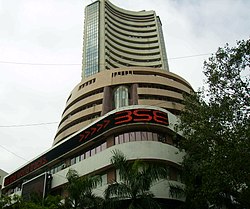
The Sensex closed at 77,264.51 on Friday, up 330.92 points, or 0.43%. The Nifty 50 added 84.80 points, or 0.35%, to end at 24,175.65. After two straight days of losses, that reads as relief — the market found its footing. It did, but not for a reason that has anything to do with India. The entire gain traces back to one company's earnings call, on a different continent, the night before: Nvidia's. The Nifty IT index jumped 2.92% to close at 31,103.45, and IT was, by a wide margin, the best-performing sector of the day. Everything else the index measures was closer to flat, or worse.
One earnings call, one sector, one index
Nvidia's results beat expectations and reset the market's mood on global AI spending overnight. Indian IT services companies don't sell chips and had no results of their own due that day, but their stock prices moved as if they had. HCLTech and TCS both gained roughly 4%. Coforge, Tech Mahindra, Persistent Systems, Infosys and Oracle Financial Services all moved close to 3% higher. That is not a coincidence of timing — it is the direct transmission mechanism. Indian IT majors are read by traders as a proxy for global technology and AI-infrastructure spending, because a meaningful share of their revenue comes from exactly the US enterprise clients who fund that spending. When sentiment on that trade turns, in either direction, the read-through to Bengaluru and Mumbai-listed IT stocks tends to be near-immediate, regardless of anything happening inside those Indian companies that week.
Two more factors did real, if smaller, work alongside the Nvidia jolt. Fed rate-cut expectations firmed up, which tends to lift risk appetite broadly and technology stocks specifically. And the rupee weakened against the dollar over the same stretch — a currency move that mechanically flatters IT firms' reported revenue and margins, since their contracts are largely dollar-denominated and a weaker rupee means each dollar of billing converts into more rupees on the income statement. None of that required a single Indian IT company to have done anything differently on Friday than it did on Thursday.
What the rest of the market actually did
| Sector | Move | Direction |
|---|---|---|
| Nifty IT | +2.92% | Led the index, on the Nvidia trade |
| Pharma | +0.53% | Modest, domestically-oriented gain |
| Bank Nifty | -0.02% | Effectively flat |
| Consumer Durables | Weak | Notable drag |
| FMCG | Weak | Notable drag |
| Energy | Weak | Notable drag |
Bank Nifty, the sector most tied to the domestic credit and consumption cycle, barely moved — a marginal decline of 0.02%, close enough to flat to call it a non-event. ICICI Bank, Shriram Finance and ITC were among the day's biggest individual losers. Pharma, another largely domestically-anchored sector, added a modest 0.53%, nowhere near IT's pace. Consumer durables, FMCG and energy all closed weak. Strip IT out of Friday's session and the picture is a market that mostly went nowhere, with a handful of domestic-facing names actually losing ground.
Why "the market rallied" is the wrong headline
This is the same mechanical point this site made two days ago about a Sensex fall driven by three heavyweight losers rather than a broad sell-off — cap-weighted indices let a concentrated move in a handful of large stocks stand in for "the market" in headlines, when the more accurate description is that a specific sector or trade did the work. Friday is that pattern running in reverse: a green index, driven almost entirely by one sector's reaction to one company's results on the other side of the world, while the parts of the market most exposed to the actual Indian economy — banks, consumer durables, FMCG — sat still or slipped. Both descriptions of Friday are technically true. "The Sensex rallied" and "the domestic economy showed no particular strength today" are not contradictory statements; they are the same session described from two different altitudes.
The exposure this creates
The more interesting question Friday raises isn't about Friday itself — it's about what it says regarding how Indian equity benchmarks now move. Nifty IT's weight in the Nifty 50 means a swing in US AI-infrastructure sentiment can move the headline Indian index by itself, independent of anything in the Reserve Bank's data releases, GST collections, or corporate earnings from India-facing businesses. That works in both directions: Friday's gain arrived by way of Nvidia's earnings beat, which means a disappointing Nvidia quarter, or a broader cooling in the AI capital-expenditure narrative in the US, could subtract from the Sensex just as mechanically as Friday's beat added to it — again, without India's own economic data needing to move at all. A market that can rally 0.43% on the back of a foreign chipmaker's earnings call is one where reading the headline number as a verdict on the Indian economy specifically, rather than on India's largest export-facing sector's read-through to a US trade, is a habit worth dropping.
None of this is a comment on where any of these stocks or indices go next — sector rotations tied to global earnings cycles reverse as often as they extend, and Friday's move says only what already happened, not what happens Monday. What it does establish is where Friday's gain actually came from, which turns out to be a shorter and more specific answer than "the market had a good day."