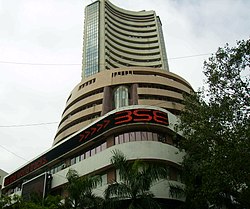
The Sensex closed down roughly 470 points on Tuesday and the Nifty slipped 141.35 points to 23,914.45, as Brent crude pushed past $94 a barrel on fresh US strikes near the Strait of Hormuz. That is a one-day story, and by Wednesday it will be replaced by another one-day story. The number that actually matters this year won't fit in a single session's headline: foreign portfolio investors have now pulled a record ₹2.87 lakh crore out of Indian equities in calendar 2026, according to NSDL data — more than the entire ₹1.66 lakh crore they withdrew in all of 2025, and among the sharpest annual sell-offs since FPIs were first allowed into Indian stocks in 1993.
A foreign exodus of that size, on its own, is the kind of number that should have put a real dent in the index. It hasn't. The Sensex and Nifty are both within a few percent of their highs for the year. The reason isn't a mystery, and it isn't really even contested among market watchers: somebody else has been buying almost everything foreign investors sold.
Who's actually holding up the market
That somebody is India's own mutual fund industry, and increasingly, the retail investors funding it through SIPs. SEBI's own numbers for FY26 (April 2025–March 2026) show domestic institutional investors pumped a record ₹8.5 lakh crore into Indian equities, against FPI outflows of ₹1.8 lakh crore over that same fiscal year — mutual funds alone accounted for ₹6.4 lakh crore of the domestic total, most of it arriving in the steady, undramatic form of monthly SIP contributions rather than one-off institutional bets. March alone brought in ₹32,087 crore of fresh SIP money, up 7.5% from February.
The scale of that flow has changed who actually owns Indian companies. DII ownership of the listed universe has climbed to an all-time high of 17%. FPI ownership, over the same stretch, has fallen to a 15-year low of 15.8%. For most of the last two decades, foreign money set the tone for Indian markets — when FPIs sold hard, the index generally followed. That relationship has visibly weakened in 2026, and the ownership numbers explain why: the marginal buyer on a bad day is now more likely to be a mutual fund manager deploying this month's SIP book than a foreign desk in Singapore or London.
| Foreign portfolio investors (FPIs) | Domestic institutions (DIIs) | |
|---|---|---|
| 2026 flow so far | −₹2.87 lakh crore (outflow, calendar YTD) | Record inflows, mutual funds leading |
| FY26 flow (SEBI) | −₹1.8 lakh crore | +₹8.5 lakh crore |
| Share of listed universe | 15.8% (15-year low) | 17% (all-time high) |
| Typical behaviour | Reacts fast to global rates, currency, geopolitics | Steady, SIP-driven, less reactive day to day |
Why the foreign money is leaving
The FPI selling isn't one story, it's three overlapping ones: US interest rates have stayed high enough for long enough to make dollar assets competitive again; the rupee, trading near ₹95–96 to the dollar, erodes returns for anyone converting gains back into foreign currency; and stretched valuations on Indian large-caps have made the risk-reward look worse relative to other emerging markets. Crude oil spikes tied to Middle East tension — like Tuesday's — pile directly onto that last point, since expensive oil both worsens India's import bill and revives inflation-and-rate-cut uncertainty that foreign desks price defensively. March 2026 alone saw a record single-month outflow of ₹1.17 lakh crore, the clearest sign that this wasn't gradual profit-booking but a genuine risk-off call on India specifically.
The part that isn't obviously good news
None of this means Indian retail investors are simply "winning" where foreign investors are wrong — betting the house on SIP money being permanently more patient than FPI money is itself a bet, and it's one that's never been tested at real scale in a genuine domestic downturn. SIP flows have grown through a multi-year period of rising markets and rising incomes; nobody has yet seen what a sharp, sustained correction does to monthly SIP retention when the account statement turns red for the first time in years. Demat account numbers have crossed 22.5 crore, meaning a meaningfully larger and less experienced share of India's population than ever before now has money sitting directly in equities, often via the same handful of large mutual fund houses. If SIP discipline holds even through a bad year, 2026 will be remembered as the year Indian markets structurally decoupled from foreign sentiment. If it doesn't, the same DII wall that's absorbing today's FPI selling becomes the mechanism by which a wobble in domestic retail confidence turns into a much sharper fall than foreign selling alone ever produced.
What Tuesday's session actually was
Seen against that backdrop, Tuesday's roughly half-percent dip on a crude oil spike is close to a non-event — a foreign, geopolitical shock landing on a market where the marginal buyer, for the first time in a generation, isn't obviously foreign money at all. That is the more durable story sitting underneath every individual day's Sensex headline this year, and it's the one worth watching through the rest of 2026, not because any single session proves it, but because the ownership numbers behind it have moved further and faster than at almost any point in the index's history.